
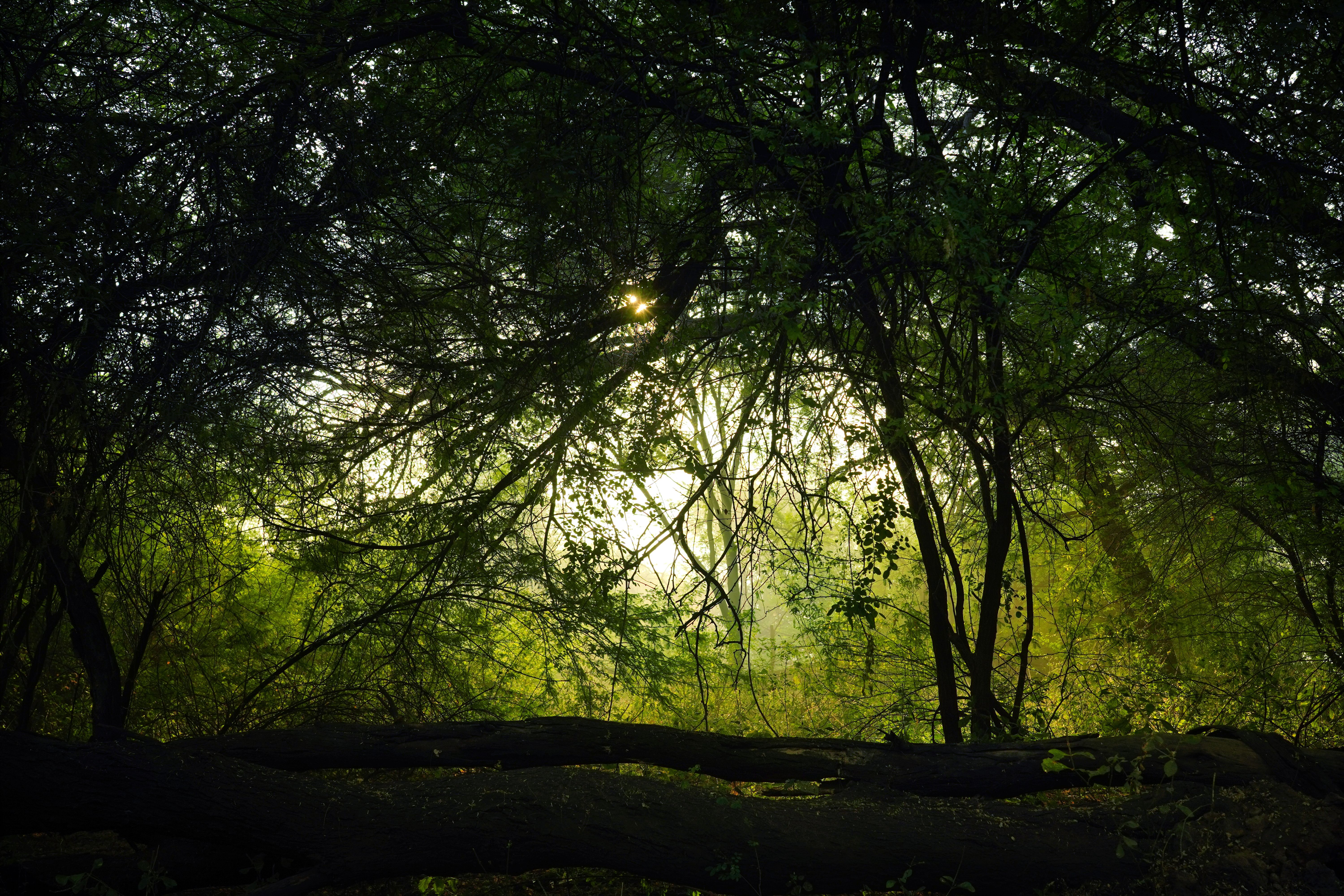
Studies on time spent in natural environments have produced reasonably consistent results across several countries.
What is measured
Self-reported wellbeing, stress markers and recovery after attention-demanding tasks.
Which are different outcomes with different evidence quality.
Dose relationships
Studies suggesting a weekly threshold associated with reported benefit.
Which has been replicated in large samples.
Competing explanations
Physical activity, social contact and reduced screen exposure.
Which are hard to separate from the environment itself.
Access as a factor
Green space distributed unevenly across populations.
Forest bathing studies
Research originating in Japan on time spent in woodland.
Which reported physiological changes and has been criticised on methodological grounds.
Later and larger studies have found smaller effects than the early work suggested.
Urban green space
Population-level associations with mental health outcomes.
Which are consistent across several countries.
Views from windows
Early hospital research on recovery rates.
Which is frequently cited and rests on a small sample.
What is plausible
Modest, real benefits from regular time outdoors.
Which does not require any of the stronger claims to be true.
Access and inequality
Green space availability tracking income closely in most cities.
Attention restoration theory
The proposal that natural environments allow directed attention to recover.
Which is a specific hypothesis with mixed experimental support.
It is frequently cited as established when it remains an active area of disagreement.
Stress reduction accounts
A competing explanation based on rapid physiological response to natural scenes.
Which makes different predictions.
Measuring exposure
Self-report, satellite data and location tracking.
Which produce different results in the same populations.
What is practically useful
Regular time outdoors, in whatever green space is available.
Which requires no theoretical commitment.
Policy implications
Green space provision as a public health question.
How to read the claims
Much of what circulates comes from small studies, sometimes with commercial interests attached.
Which does not make the underlying idea wrong.
The broad finding, that regular time outdoors is associated with better reported wellbeing, is reasonably robust; the specific mechanisms and dose claims are not.
Types of environment
Woodland, coast, parks and gardens.
Which may not be equivalent and are frequently treated as such.
Gardening
Studied separately with its own reasonably positive literature.
Children and outdoor time
Substantial declines in unsupervised outdoor play over recent decades.
Which is a documented change with contested consequences.
The practical version
Go outside regularly, wherever you can, and do not overthink it.
Why the findings are hard to pin down
Time outdoors correlates with exercise, daylight, social contact, reduced screen use and being the kind of person who goes outdoors.
Which makes isolating the environment itself genuinely difficult.
Studies that attempt it produce smaller effects than the observational literature, which is what you would expect.
Blue space
Water environments studied separately.
Which show comparable associations.
Indoor plants and views
A smaller literature with weaker findings.
Practical application
Building outdoor time into an existing routine rather than adding a new commitment.
Which is what actually persists.
A general note
This summarises research and is not a health recommendation for any condition.
How this article treats its subject
Everything here is written descriptively. Where a practice belongs to a living religious tradition, the aim is to say accurately what that tradition does and says about it, without arguing for or against its beliefs. Those are questions for the traditions themselves and for the people who belong to them.
Where research is mentioned, the intention is to report what studies have found rather than what enthusiasts or critics have claimed about them, including where the findings are weaker or more contested than popular coverage suggests.
Where to read further
Primary texts in good annotated translations, academic histories, and practitioners speaking about their own tradition are all more reliable than secondary summaries, including this one. Most of the traditions discussed here have extensive scholarly literature that is accessible to general readers, and university presses publish short introductory volumes on nearly all of them.
Where a practice has physical or psychological effects, medical and mental health professionals are the appropriate source of guidance, and nothing here is intended as advice of that kind.
A note on why history matters here
A great deal of contemporary spiritual and wellbeing material presents itself as ancient when it is recent, or as universal when it belongs to a particular tradition and place. Neither of those is necessarily dishonest, and both make it harder to understand what one is actually doing.
Knowing where a practice comes from, who developed it, what it was originally for and what changed along the way does not diminish it. It usually makes it more interesting, and it makes claims about it easier to evaluate.
On sources and disagreement
Scholars disagree about much of this material, sometimes sharply, and where that is the case it has been noted rather than resolved. Presenting contested questions as settled would be more comfortable to read and less accurate.